The Bias Cut: Why Fabric Falls Differently
The bias cut lets fabric move differently from a straight grain. Learn how to spot it in a garment and what its drape can tell you.
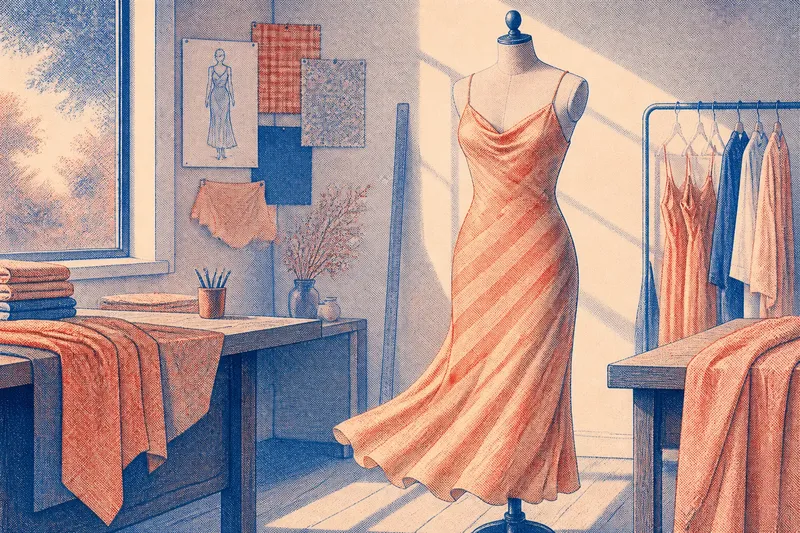
A bias cut lets fabric stretch and swing where a straight-grain cut tends to hold its shape. To understand why a dress twists gently around the body or a skirt hangs in a soft curve, look at the direction of its threads before judging the fabric itself.
The bias is not a special fabric or a decorative finish. It is a way of cutting woven cloth, and it changes how that cloth responds to gravity, movement and the body beneath it. You can use the idea to read a garment more closely, whether you are choosing one, assessing its fit or simply wondering why its hem refuses to hang like a ruler.
Find the grain
Woven fabric is made from two thread systems crossing at right angles. The lengthwise threads, or warp, run parallel to the selvedge: the finished edge that often remains along the sides of a fabric roll. The crosswise threads, or weft, run from one selvedge to the other.
A garment panel cut with its edges parallel to either thread direction is on the straight grain. A true bias cut runs diagonally across both systems, commonly at about forty-five degrees. In practice, a pattern may use a shallower or steeper diagonal, so “bias” does not always mean every piece sits at precisely the same angle.
When you inspect a finished garment, the original fabric roll and its selvedge are usually out of reach. Look instead for clues in seams and surface pattern. A check or stripe that crosses the body diagonally, especially when neighbouring panels mirror one another, can indicate bias placement. It is a clue, not proof: pattern matching can create a diagonal effect without a bias cut.
Understand the movement
Woven cloth often has limited give along the warp and weft. On the diagonal, the threads can shift against one another more readily, giving the cloth extra flexibility without adding elastane. That shift is what allows bias-cut panels to mould and move differently.
The result depends on the cloth. A light satin may fall into fluid folds; a crisp cotton may show a quieter curve and more resistance. The bias does not make every fabric cling, flow or stretch in the same way. It changes the conditions under which the fabric hangs, while fibre, weave, weight and finish still have a say.
Gravity becomes unusually visible. A bias-cut skirt can settle into diagonal folds, and a bias-cut dress may follow the body at the waist or hip before releasing lower down. When the wearer moves, the cloth can swing and recover with a softness that a straight-grain panel of the same fabric may not share.
There is a trade-off: that flexibility can also make a panel shift while it is handled or sewn. A hanging garment may relax and lengthen unevenly, particularly around a curved hem. A well-made bias garment accounts for that behaviour through pattern shape, construction and finishing; the fabric’s movement is not a flaw by itself.
Read the garment
Start by letting the garment hang naturally. Hold it by its shoulders or waistband rather than pulling the hem level, then notice whether seams fall straight, angle around the body or appear to spiral slightly. A bias-cut garment may hang on a diagonal even when the wearer is standing still.
Next, inspect the fabric pattern. If stripes or checks run diagonally across a panel, trace their direction towards the seams. Ask whether the adjoining panels continue the pattern deliberately or change direction at a seam. A diagonal print can be cut on straight grain, and a plain fabric can be cut on the bias, so treat the print as supporting evidence rather than a verdict.
Then look at how the garment behaves when worn. Does it skim, twist, cling or swing? Does the fabric respond evenly on both sides, or does one area seem to pull? Bias construction may explain a fluid silhouette, but fit, seam placement, lining and the fabric’s own weight also affect what you see.
Say you are considering an unlined satin skirt that hangs in a soft diagonal fold from the hip. If its stripes also cross the panels diagonally and the side seams curve gently rather than dropping squarely, those clues together suggest bias construction. The useful next check is not to assume it will fit every body the same way, but to see whether the waist sits comfortably and the folds settle where you want them.
What is not worth the effort: trying to identify the exact cutting angle by eye. Unless you are studying a pattern or making a garment, recognising the general diagonal orientation and observing its effect are enough.
Choose by purpose
Bias construction can suit garments meant to move close to the body without relying on rigid shaping. Slip dresses, camisoles, skirts and scarves often use it to create a fluid line or a graceful swing. The same fabric on straight grain may look more stable and structured, which may be preferable when a garment needs to keep a crisp outline.
Think about where you want the cloth to move. A bias-cut skirt can accommodate a walking stride with a soft release through the hem; a straight-grain skirt in a similar weave may preserve a more fixed silhouette. For a top, bias panels can follow curves, but the resulting drape may reveal more of the body’s contours than a wearer expects.
Inspect construction as well as appearance. Seams should lie smoothly rather than puckering, and a hem should not look abruptly uneven when the garment is allowed to hang. A lining can steady the outer fabric, though its own cut and attachment affect how freely the garment moves. A rigid lining may restrain a fluid shell; a more compatible one may preserve its fall.
When deciding whether a bias-cut garment suits you, focus on the actual garment rather than the promise of the technique. Check its comfort while standing, sitting and walking. Notice whether the fabric clings where you prefer a looser line, or whether the movement gives the shape the ease you wanted. The bias offers a particular kind of flexibility, not an automatic improvement.
Common questions?
Does bias cut mean stretch fabric?
No. Bias describes the direction in which woven cloth is cut, not the fibre or a stretch treatment. The diagonal can give woven fabric more give, but it does not behave exactly like knitted cloth or fabric containing elastane.
How can I spot bias cutting?
Look for diagonal grain or print direction, fluid folds and seams that sit at an angle around the body. No single sign settles the question: a diagonal print may be placed on straight grain, while a plain panel offers little visual evidence.
Why might a bias hem look uneven?
Diagonal sections can relax and hang lower as the cloth settles under its own weight. A shifting hem does not alone show poor workmanship, though a conspicuously uneven finish or twisted seams may affect how the garment looks and feels.
Is bias cutting suitable for every fabric?
It can be used with many woven fabrics, but the result depends on how each cloth responds. Very crisp or heavy material may show less fluid movement, while a light, supple weave may make the diagonal drape more apparent.
Care for the drape
Bias garments benefit from being handled without tugging, especially when wet or freshly washed, because their diagonal structure can shift more easily under strain. Follow the care label and any maker instructions for washing, drying and pressing; those directions matter more than a general rule about fibre or cut.
When storing a particularly fluid garment, consider whether a hanger is stretching its shoulders or whether folded storage is distorting its folds. The best choice depends on the garment’s construction and the space available. Smooth, unforced storage helps the fabric retain the fall you chose it for.
The bias cut is easiest to recognise by combining clues: the thread direction, the way seams sit and the way the cloth settles in motion. Keep those observations in mind when reading a garment’s drape. They help distinguish a deliberate, fluid line from a fabric that simply happens to be soft.