A Wardrobe Sorted by Colour Can Hide What You Wear
A wardrobe sorted by colour looks orderly but can conceal what earns its place. Sort by use and occasion to see what you actually wear.
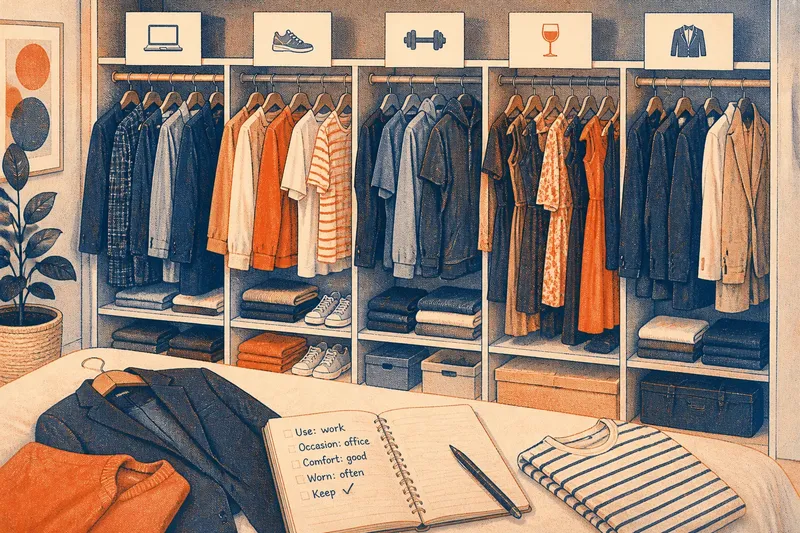
A wardrobe sorted by colour can make a rail look composed while hiding the clothes that carry most of your week. A navy shirt for work, a navy shirt for weekends and a navy shirt kept for formal occasions sit together as though they serve the same purpose. To understand what is actually worn, sort by use and occasion first; colour can still help within those groups.
What colour conceals
Colour is easy to see, so it makes a satisfying organising principle. Shirts gather beside shirts, dark trousers form a neat run, and the eye can scan for a shade without searching every hanger. That is a useful way to find something. It is a less useful way to understand why it is there.
Garments of the same colour can have very different jobs. A black jumper might be a dependable layer for a cold commute, a smart option for dinner, or an uncomfortable purchase worn only when laundry has narrowed the field. Grouping them by shade erases those distinctions. The rail looks consistent; the evidence about use becomes harder to read.
Colour can also make repetition appear more or less significant. Several pale shirts may look like a collection, although one is worn constantly and the others are too formal or awkward at the collar. A row of dark pieces may seem redundant even when each suits a different setting. The useful question is not simply how many similar colours are present, but what each garment enables you to do.
Sort by use
A use-based arrangement groups clothes by the activity they support. The categories need not be elaborate: work, everyday errands, home, exercise, social occasions and formal events may be enough. A garment can have more than one job, so choose the category where it earns its place most often rather than trying to give every item a rigid identity.
This approach suits anyone whose week has recognisable routines, especially when the same colours appear in both casual and dressier clothes. It can reveal a practical gap as well as a surplus: perhaps there are plenty of shirts for meetings but little that feels comfortable for travel, or several smart skirts but no shoes that make them workable for an ordinary day.
Use is not the same as frequency alone. A waterproof coat may be worn less often than a cardigan and still be essential when the weather turns. A formal outfit may have a specific, infrequent purpose. The point is to distinguish those deliberate roles from garments that have no clear place and remain on the rail by default.
Say you work from home most days, go to an office occasionally and own three dark jackets. If you group the jackets by use, you might find one is comfortable for daily wear, one suits the office, and one has not left its hanger because its shoulders feel restrictive. That arrangement makes the next decision visible: keep the first two in their working groups and reconsider the third, rather than treating all three as interchangeable because they share a colour.
Sort by occasion
Occasion-based sorting starts with the settings in which clothes are worn: a workplace with a dress code, a casual lunch, a ceremony, a journey or a wet walk. It is more specific than broad use categories, and it can clarify why an item that seems rarely worn still matters. A suit reserved for formal appointments is not necessarily a failed everyday garment.
This approach suits people whose clothes must meet noticeably different expectations across the week. It is also useful when the wardrobe contains a few specialised pieces, such as a washable outfit for practical work or a coat suitable for a particular kind of weather. Once these roles are visible, it becomes easier to judge whether a garment is genuinely useful or merely attached to an imagined occasion.
There is a risk of making the categories too narrow. If every invitation, venue or possible social mood receives its own section, the arrangement becomes a filing system for events that may never happen. Keep occasions broad enough to match real patterns in your life. “Work” is usually more helpful than separate labels for every meeting type.
Use and occasion overlap, but they answer different questions. “Everyday” asks what a garment does in regular life; “smart casual” or “formal” describes the setting it is suited to. A pair of trousers might belong among everyday work clothes, while another pair is kept for occasions that call for a sharper finish. The distinction helps prevent a single vague category such as “nice clothes” from swallowing pieces with quite different purposes.
Keep colour as support
A colour arrangement still has its uses. It suits someone who knows what they want by shade, dresses from a narrow palette, or shares storage with others and needs a quick visual system. It can be especially convenient inside a category: arrange work shirts from light to dark, or group everyday knitwear by colour once its role is clear.
Think of colour as a secondary index rather than the main account of the wardrobe. First group by use or occasion; then order each group by garment type, colour or whatever makes finding items straightforward. This preserves the quick visual scan without asking shade to explain frequency, comfort or context.
Not every piece needs a single permanent home. A jacket used for work and dinners can sit in a mixed-use section, or be placed where it is easiest to reach. The system is there to make choices clearer, not to turn a hanger into a legal address. If you repeatedly move one item between sections, that may be useful information: its role is flexible, or the categories need simplifying.
Choosing an arrangement
Choose according to the question you want the wardrobe to answer. If the problem is finding a particular shade quickly, colour is perfectly adequate. If you are trying to see what supports your routine, sort by use. If you need to separate clothes for contrasting settings, sort by occasion. A mixed approach is often the least fussy: broad use groups, with colour as the final visual order.
Try a temporary arrangement before changing every hanger. Move one category—perhaps work clothes—into a separate section and notice whether it becomes easier to select an outfit and spot unused pieces. If the grouping creates more confusion than clarity, adjust the labels or return to a simpler system. There is no virtue in a beautifully organised rail that makes getting dressed feel like an audit.
For a useful trial, choose a category you reach for often and consider each item in turn:
- Use: What activity does this garment support in ordinary life?
- Occasion: Does it belong to a particular setting or level of formality?
- Frequency: Is it worn regularly, seasonally or only for a deliberate reason?
- Comfort: Does its fit, fabric or fastening make it easy to choose?
- Overlap: Does another item do the same job more comfortably or appropriately?
- Access: Should it be within easy reach, stored with seasonal pieces or kept for a specific event?
These questions are not a demand to remove anything. They help separate a garment with a quiet, specific role from one that simply resembles clothes you wear. A piece may be infrequent and still earn its place; another may be easy to overlook precisely because it resembles a more useful neighbour.
Questions about sorting?
Should clothes be sorted by colour or type?
Sort by type when you need to compare similar garments, such as trousers or knitwear. Use colour within those groups if it helps you find a shade quickly; neither arrangement needs to stand alone.
How can I tell what I actually wear?
Notice which garments you reach for during familiar routines and which remain untouched despite being easy to see. A simple note on the wardrobe door can record broad use or occasion without turning dressing into a daily inventory.
What if one garment suits several occasions?
Place it where you are most likely to look for it, then note its other role in your own mental map or on a removable label. Flexibility is a useful feature, not a filing error.
Is a colour-sorted wardrobe ever a bad idea?
It becomes unhelpful when the visual order hides differences in comfort, purpose or how often clothes are used. If it already makes your choices clear, there is no need to replace it for the sake of a new system.
Leave room for use
A wardrobe sorted by colour is not wrong; it answers a narrow question well. For a clearer account of what gets worn, let use and occasion shape the main groups, then keep colour where it helps with quick decisions. The best arrangement is the one that shows both what a garment looks like and what place it has in your actual week.
It is not worth the effort to relabel every hanger, build a complex category scheme or track each wear indefinitely. A small shift in one section can tell you whether the new view is more revealing. Keep the system that makes the next useful choice easier, and let the rest remain pleasantly unclassified.